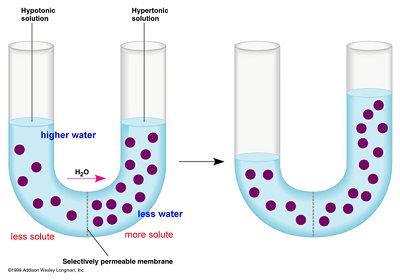
Diffusion is the net movement of particles from a region where they are at a higher concentration to region where they are at a lower concentration. ( Definition from notes )
Osmosis is a special type of diffusion, it is the diffusion of water molecules through a semipermeable membrane. So basically, if it is not water that is being diffused and there is no semipermeable membrane, then it is not diffusion.
This is one of those topics that I really had no idea existed until I was taught. Thus, when the teacher asked me to define the meaning of diffusion and osmosis, I just said that I did not know. However, once you understand what they mean, this topic gets a lot more easier.
This is an example of osmosis, a special kind of diffusion
Thursday, 8 September 2011
Separation Techniques
There are many different separation techniques and they include simple distillation, fractional distillation, evaporation, filtration, magnetic separation, heating, passing an electric curremt and chromatography. Those were the separation techniques taught to us but as for others, they were not taught yet and so I cannot really name them.
This is linked to mixtures and compounds but is basically purely focusing on how to separate them. Physical methods are for mixtures while chemical methods are for compounds. However, we only focused on physical methods in class and practicals.
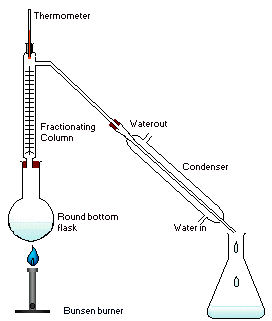
This is an example of fractional distillation
This is linked to mixtures and compounds but is basically purely focusing on how to separate them. Physical methods are for mixtures while chemical methods are for compounds. However, we only focused on physical methods in class and practicals.
This is an example of fractional distillation
Solution and Suspension
A solution is a mixture where one or more solutes dissolve in a solvent. A suspensions is a mixture where solid or liquid particles are suspended in a liquid or gas
Well, I suppose the biggest takeaway I got from this topic was probably that Milo is not a solution but a suspension. However, I wonder, if Milo is a suspension, then why do we need to use hot water to make sure that all the powder "dissolves"?
Elements, Compounds and Mixtures
Elements are the simplest form of matter and cannot be broken down into simpler substances. Compounds are different elements combined in a definite proportion by mass. Mixtures are different elements mixed in any fixed proportion.
I know that was a boring explanation but what else can I say. I cannot for some reason, understand the table of elements but somehow, I think that this topic is really interesting. I cannot really explain it but I really had more fun in lessons of elements that other topics.
This is the periofic table of elements
I know that was a boring explanation but what else can I say. I cannot for some reason, understand the table of elements but somehow, I think that this topic is really interesting. I cannot really explain it but I really had more fun in lessons of elements that other topics.
This is the periofic table of elements
Density & Kinetic Particle theory
Not much to say about these two really, that's why I put them together. Density is mass/volume, however, this topic is not easy as the questions they come up with in the tests are very tricky. As for the kinetic particular theory, it basically means that all matter are made up of atoms and are in continuous, random motion but the inter-molecular forces hold the atoms together. Also, these inter-molecular forces are strongest in the solid state, weaker in the liquid state and weakest in the gaseous state.
I like kinetic particle theory the most as it is the the easiest but density is especially hard for me. This is because it is a seemingly easy topic but I somehow cannot solve the questions in the test paper.
Measurements and Units
This topic is mainly about understanding the different instruments of measurements, the exact method of measurement and the standard units from which all the other units are derived. An example would be Kelvin for temperature and meter for length. We also learn to give our answers up to a certain number of significant figures as sometimes, too many digits are redundant and serve only to confuse us.
This topic is interesting but I do not personally feel that this subject is that important as it is somewhat like Mathematics. Furthermore, the story of the standard units is interesting but I do not see why we must really learn any of this since we will most probably get it in time.
Science as an inquiry
This topic is mainly about understanding the uses different types apparatus, how exactly to use a Bunsen burner, the steps to conduct a proper scientific experiment, the mentality that a scientist should have, the lab safety rules and the meanings of certain safety symbols such as this one
I think this topic is actually the most useful, although many will disagree as this topic really has not much "knowledge" that we have to be aware of. However, it teaches you exactly what science is about and teaches you all the basics. Some may say that these are unnecessary but this is extremely important for aspiring scientists and furthermore, would it not be embarrassing in a test if we did not even know what a crucible was or what it does
Subscribe to:
Posts (Atom)